Ingredients
This recipe serves approximately 6–8 people.
- 3–4 pounds boneless top sirloin roast or another suitable beef roasting cut
- 4 tablespoons unsalted butter, softened
- 4 cloves garlic, minced
- 1 tablespoon olive oil
- 2 teaspoons kosher salt
- 1 teaspoon freshly ground black pepper
- 1 tablespoon fresh rosemary, finely chopped
- 1 tablespoon fresh thyme leaves
- 1 teaspoon onion powder
- 1 teaspoon smoked paprika, optional
- 1 tablespoon Worcestershire sauce, optional
For the Roasting Pan:
- 1 large yellow onion, sliced
- 1 cup low-sodium beef broth
- 2–3 sprigs fresh rosemary
- 2–3 sprigs fresh thyme
Optional for Serving:
- Homemade beef gravy
- Fresh rosemary for garnish
- Creamy mashed potatoes
- Roasted carrots
- Green beans
- Yorkshire puddings
Instructions
Remove the beef roast from its packaging and pat it thoroughly dry with paper towels.
If the roast has excess loose fat or uneven pieces, trim them carefully while leaving a thin layer of fat where appropriate.
For more even cooking, tie the roast with kitchen twine at 1½–2-inch intervals if it is irregularly shaped. This helps it maintain a more uniform shape while roasting.
For better seasoning, salt the roast several hours ahead or overnight in the refrigerator, uncovered, if you have time. If preparing it immediately, simply season it as directed.
Let the roast sit at room temperature for approximately 30–45 minutes while you prepare the garlic butter. This helps take the chill off the meat, although it does not replace using a thermometer to check doneness.
Step 2: Prepare the Garlic Herb Butter
In a small bowl, combine the softened butter, minced garlic, olive oil, chopped rosemary, thyme, black pepper, onion powder, smoked paprika, and Worcestershire sauce if using.
Mix until everything is evenly combined.
Taste a tiny amount of the butter mixture and adjust the seasoning if needed, keeping in mind that the roast will also be seasoned with salt.
Step 3: Season the Roast
Sprinkle the kosher salt evenly over all sides of the beef roast.
Rub the garlic herb butter mixture over the entire surface, including the sides and ends.
Use your hands or a small spatula to spread the mixture evenly so every part of the roast receives plenty of flavor.
For an extra-rich crust, make sure the herb butter reaches the edges rather than collecting only on top.
Step 4: Prepare the Roasting Pan
Preheat your oven to 450°F (232°C).
Arrange the sliced onion in the bottom of a roasting pan. Add the beef broth, rosemary sprigs, and thyme sprigs.
Place a roasting rack inside the pan and position the seasoned beef roast on top, fat side up if the cut has a fat cap.
The roast should sit above the liquid rather than being submerged in it.
Step 5: Roast at High Temperature
Place the roast in the preheated oven and cook at 450°F (232°C) for approximately 15 minutes.
This initial high-temperature roasting helps develop a flavorful, browned exterior.
Avoid opening the oven repeatedly because this allows heat to escape and can affect cooking time.
Step 6: Reduce the Temperature and Continue Cooking
After the first 15 minutes, reduce the oven temperature to 325°F (163°C).
Continue roasting until the center reaches your desired temperature.
Cooking time depends on the exact cut, thickness, starting temperature, oven, and shape of the roast. For a 3–4-pound top sirloin roast, the total roasting time may be around 1½–2 hours, but this is only a planning estimate.
Begin checking the internal temperature well before the expected finish time. Insert an instant-read thermometer into the thickest part of the roast, avoiding large areas of fat.
For a whole beef roast, the USDA recommends reaching 145°F (63°C), followed by at least a 3-minute rest. If you prefer a more thoroughly cooked roast, continue cooking to a higher temperature, understanding that leaner cuts may become drier.
Step 7: Rest Before Slicing
Remove the roast from the oven once it reaches the appropriate temperature.
Transfer it to a cutting board and loosely cover it with foil.
Allow the roast to rest for at least 15–20 minutes before slicing. Resting helps the juices redistribute and makes the beef easier to carve.
Do not slice immediately after removing it from the oven, or you may lose more of the flavorful juices.
Step 8: Slice and Serve
Remove the kitchen twine if used.
Use a sharp carving knife to slice the roast against the grain. For lean cuts such as sirloin or eye of round, thin slices are usually the most tender.
Arrange the beef on a warm serving platter and spoon a little of the flavorful pan juices over the slices.
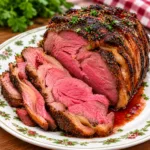
Garnish with fresh rosemary and thyme for a beautiful Christmas presentation.
Serve with mashed potatoes, roasted vegetables, and homemade beef gravy.
Notes
Choose the right cut. A top sirloin roast is a good choice for a traditional roast beef texture. Lean round roasts are more affordable but should be sliced thinly against the grain. Chuck roast needs a different, slower cooking approach.
Use a meat thermometer. This is the most reliable way to avoid overcooking. Roasting time alone cannot guarantee the correct doneness.
Dry the surface before seasoning. Patting the beef dry helps the garlic butter adhere and encourages better browning.
Season ahead when possible. Salting the roast several hours in advance can improve flavor throughout the meat.
Don’t add too much liquid. The broth should sit in the bottom of the pan, not cover the beef. The goal is roasting, not boiling.
Rest before carving. Allowing the roast to rest helps keep the slices juicy.
Slice against the grain. This is particularly important for lean cuts because it shortens the muscle fibers and makes each bite easier to chew.
Adjust cooking time for the shape. A long, narrow roast may cook faster than a thick, compact roast of the same weight.