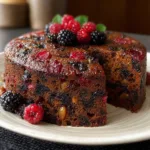
Description
Nothing captures the warmth and nostalgia of the holiday season quite like a homemade Christmas Dark Fruit Cake. Rich, moist, deeply flavored, and filled with colorful dried fruits, crunchy nuts, warm spices, and a beautiful dark crumb, this traditional Christmas dessert has earned its place on holiday tables for generations.
Ingredients
For the dried fruit mixture
- 2 cups (300 g) raisins: Provide natural sweetness and a classic fruitcake flavor.
- 1 cup (150 g) chopped dates: Add moisture, richness, and a naturally caramel-like taste.
- 1 cup (150 g) mixed candied peel and chopped candied cherries: Bring bright color and traditional holiday flavor.
- 1/2 cup (75 g) dried cranberries: Add a pleasant tartness that balances the sweetness.
- 1/2 cup (75 g) chopped dried apricots: Provide a soft texture and fruity flavor.
- 1/2 cup (120 ml) orange juice: Helps soften the fruit and adds citrus flavor.
- 1/4 cup (60 ml) water or apple juice: Provides additional liquid for soaking.
- 1 tablespoon finely grated orange zest: Adds a fresh, fragrant citrus note.
You can substitute other dried fruits, such as currants, chopped prunes, or additional raisins, depending on your preferences.
For the cake batter
- 2 cups (250 g) all-purpose flour: Forms the structure of the cake.
- 1 cup (200 g) packed dark brown sugar: Adds sweetness, moisture, and a deeper caramel flavor.
- 1/2 cup (113 g) unsalted butter, softened: Creates a rich, tender crumb.
- 3 large eggs, at room temperature: Bind the ingredients together and support the cake’s structure.
- 1/4 cup (60 ml) molasses or dark treacle: Gives the cake its signature dark color and robust flavor.
- 1/2 cup (60 g) chopped walnuts or pecans: Add a delicious nutty crunch.
- 1 teaspoon baking powder: Helps the cake rise slightly.
- 1 teaspoon ground cinnamon: Provides warm, familiar holiday flavor.
- 1/2 teaspoon ground nutmeg: Adds aromatic depth.
- 1/4 teaspoon ground cloves: Gives the cake a traditional spiced flavor.
- 1/2 teaspoon ground ginger, optional: Adds a subtle warming note.
- 1/2 teaspoon salt: Balances the sweetness.
- 1 teaspoon vanilla extract: Enhances the fruit and spice flavors.
- 2 tablespoons all-purpose flour, reserved for coating the fruit: Helps distribute the fruit evenly through the batter.
Optional finishing ingredients
- A little orange juice or apple juice for brushing the cooled cake
- Extra chopped nuts for decoration
- A light dusting of powdered sugar
- Candied cherries or strips of candied orange peel
- A small amount of brandy or rum for an alcoholic version, if desired
Instructions
Begin by preparing the dried fruit mixture. Place the raisins, chopped dates, candied peel, candied cherries, dried cranberries, and chopped dried apricots in a large bowl.
Pour in the orange juice and water or apple juice. Add the grated orange zest and stir until the fruit is evenly coated.
Cover the bowl and allow the fruit to soak for at least 30 minutes. For a softer, more flavorful mixture, refrigerate it for several hours or overnight.
Soaking helps the fruit absorb moisture, making it softer and more pleasant to eat in the finished cake. It also allows the citrus flavors to spread throughout the mixture.
If you soak the fruit overnight, keep it refrigerated and bring it closer to room temperature before preparing the batter. If there is excess liquid after soaking, do not automatically discard it; incorporate an appropriate amount into the batter so that the cake retains its moisture without becoming overly wet.
Step 2: Prepare the oven and cake pan
Preheat your oven to 300°F (150°C). A relatively low baking temperature is useful for a dense fruit cake because it allows the center to bake without the outside becoming too dark too quickly.
Grease a deep 9-inch round cake pan and line the bottom and sides with parchment paper. If your pan is particularly shallow, choose a larger pan or divide the batter between two pans to prevent overflowing.
For an especially long baking time, you can use two layers of parchment paper around the sides of the pan. This provides additional protection against excessive browning.
Place the oven rack in the center or slightly below the center of the oven. Make sure there is enough space above the pan for heat to circulate.
Step 3: Mix the dry ingredients
In a medium bowl, whisk together the flour, baking powder, cinnamon, nutmeg, cloves, optional ginger, and salt.
Mix thoroughly so that the spices and leavening agent are evenly distributed throughout the flour.
Measure the ingredients carefully. Because this cake contains a substantial quantity of dried fruit, the batter needs enough structure to support the fruit without becoming heavy or crumbly.
Set the dry mixture aside while you prepare the butter and sugar.
Step 4: Cream the butter and brown sugar
Place the softened butter and dark brown sugar in a large mixing bowl.
Beat with an electric mixer on medium speed for approximately 2–3 minutes, until the mixture looks creamy and well combined. Scrape down the sides of the bowl as needed.
The mixture does not need to become as pale and fluffy as a light sponge cake batter. The goal is to distribute the butter and sugar evenly and incorporate a little air.
Add the eggs one at a time, beating after each addition. If the mixture begins to look slightly separated, add a spoonful of the measured flour mixture and continue mixing gently.
Stir in the molasses or dark treacle and vanilla extract. The batter should now have a rich brown color and a deep, sweet aroma.
Step 5: Add the flour and spices
Add the dry ingredients to the butter mixture in two or three additions. Mix on low speed or fold with a spatula until the flour is almost completely incorporated.
Avoid overmixing, as excessive mixing can make the cake tough.
The batter will be thicker than a typical sponge cake batter because it needs to hold a generous amount of dried fruit and nuts.
Drain any excessive soaking liquid from the fruit if necessary, reserving a little to adjust the consistency. Toss the soaked fruit and chopped nuts with the reserved 2 tablespoons of flour.
This light coating can help distribute the fruit more evenly, although it does not guarantee that every piece will remain suspended in the cake.
Step 6: Fold in the dried fruit and nuts
Add the prepared fruit and nuts to the cake batter. Fold gently with a sturdy spatula until they are evenly distributed.
Scrape the bottom and sides of the bowl to make sure no dry flour or concentrated pockets of batter remain.
If the batter seems exceptionally stiff, add a small amount of the reserved soaking liquid, one tablespoon at a time. The mixture should be thick but still possible to spread into the cake pan.
Do not add all the soaking liquid automatically. The amount absorbed by dried fruit varies, and too much liquid can make the cake take longer to bake or affect its structure.
Once the fruit and nuts are incorporated, transfer the batter to the prepared cake pan.
Step 7: Fill and prepare the cake pan
Spoon the batter into the lined pan. Use a spatula to spread it evenly, pressing gently into the corners and edges.
Smooth the top and make a slight shallow depression in the center if you wish to reduce excessive doming.
Tap the pan lightly on the countertop to release large air pockets. Avoid striking it too hard, as the batter is dense and contains plenty of fruit.
For a decorative finish, arrange a few extra nuts or candied cherries on top. Keep the decoration relatively simple so that the cake bakes evenly.
Step 8: Bake the Christmas dark fruit cake
Place the pan in the preheated oven and bake at 300°F (150°C) for approximately 2–2 1/2 hours, depending on the pan size, oven accuracy, and moisture content of the fruit.
Begin checking the cake around the 1-hour-and-45-minute mark. If the top is browning too quickly, loosely cover it with aluminum foil.
The cake is ready when a skewer inserted into the center comes out without wet batter. A few moist crumbs are acceptable, but the center should not look liquid or underbaked.
Because fruitcake is dense, a toothpick can pass through a piece of fruit and give a misleading result. Test more than one spot if necessary.
Avoid increasing the oven temperature to speed up baking. The outside may become excessively dark before the center has cooked through.
Once the cake is baked, remove it from the oven and place the pan on a heatproof rack.
Step 9: Cool the cake properly
Allow the cake to cool in its pan for approximately 20–30 minutes.
Carefully loosen the edges if necessary, then lift or turn the cake out onto a wire rack. Remove the parchment paper and allow the cake to cool completely.
Do not wrap the cake while it is still warm. Trapped steam can create condensation and make the surface wet.
A fruit cake often becomes easier to slice after resting for several hours. The fruit, spices, and molasses also have time to settle into a more harmonious flavor.
Step 10: Add moisture and finish the cake
Once the cake has cooled completely, brush the surface lightly with orange juice or apple juice if you want extra moisture and citrus flavor.
Use only a small amount at a time. Too much liquid can make the cake soggy or shorten its storage life.
For a traditional alcoholic version, a small amount of brandy or rum may be used instead, but the cake must still be stored appropriately and should not be assumed shelf-stable simply because alcohol has been added.
Decorate the cake with extra nuts, candied cherries, candied orange peel, or a light dusting of powdered sugar.
For the neatest slices, use a long, sharp knife and wipe it between cuts. Serve the cake at room temperature so that its texture and flavor are at their best.
Notes
The most important part of making a successful Christmas dark fruit cake is controlling moisture and baking temperature.
Dried fruit absorbs liquid differently depending on its size, variety, and age. If the fruit absorbs most of the soaking liquid, the batter may need a small adjustment. If it remains very wet, too much liquid can prevent the center from baking properly.
Use a low oven temperature and allow plenty of time for the center to cook. If the top becomes dark before the center is ready, cover it loosely with foil rather than raising or lowering the temperature dramatically.
Molasses and dark brown sugar give the cake a deep color, but they can also make the batter appear darker before it is fully baked. Always check the center carefully.
For the best flavor, allow the cake to rest after baking. Once cooled, wrap it well and refrigerate it if it will not be eaten within a few days. Freeze longer-term portions for better quality.
If you want to age a traditional fruit cake, use a recipe specifically formulated for that purpose and follow reliable food-storage guidance. A moist, homemade, alcohol-free cake containing juice-soaked fruit should not be stored at room temperature for weeks.
- Prep Time: 30 minutes
- Cooling Time: 1–2 hours
- Cook Time: Approximately 2–2 1/2 hours
Nutrition
- Calories: 350–450
- Sodium: 100–200 mg
- Protein: 4–6 g